
 Listing checkedFree TrialPaid
Brain.fm
Functional music subscription with Focus, Relax, Meditation and Sleep modes, adjustable stimulation, and offline playback on iOS and Android.
- Ratings
- No member reviews yet
- Price
- From $14.99/mo
- Last updated
Key takeaways
- Brain.fm sells functional music, not playlists: Focus, Relax, Meditation and Sleep modes built on rhythmic modulation, composed by humans working with AI, and delivered through the browser and iOS and Android apps with offline downloads.
- The audience is wider than the ADHD framing suggests. Students, knowledge workers, and sleep and meditation users are the marketed segments; ADHD Boost is one stimulation setting, and the company says the product is not limited to people with attention difficulties.
- Access costs $14.99 a month or $99.99 a year as of August 31, 2026, up from the $9.99 and $69.99 prices still circulating in older listings. There is no permanent free tier: the trial collects card details up front and converts to a paid plan unless cancelled.
- Third-party estimates put traffic between roughly 2.9 and 3.3 million monthly visits in mid 2026, down from about 3.75 million in January 2026. Around 63 percent of visits arrive direct, the pattern of a tool people return to rather than discover.
- The biggest caveat is billing. Trustpilot complaints from February and March 2026 allege charges before trial end and after cancellation, and the terms require cancelling at least 24 hours before renewal to avoid the next charge.

What is Brain.fm?
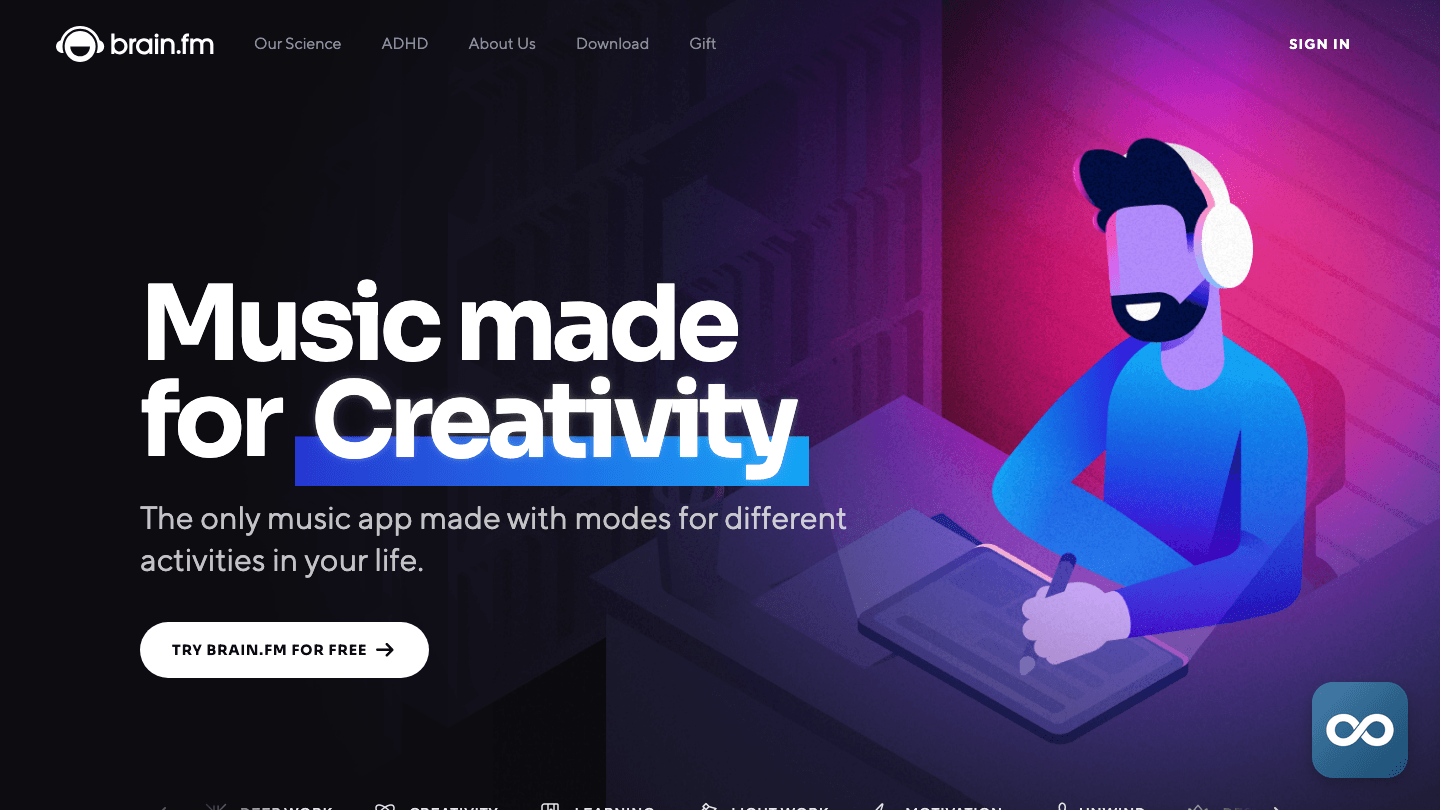
Brain.fm is a subscription service that plays music engineered to push you toward a chosen mental state: deep focus, relaxation, meditation or sleep. The homepage headline is "Music to Focus Better", and that is the core of the product. You pick a goal, the service streams functional music with rhythmic modulation layered into it, and you keep working, unwinding or falling asleep while it runs. It works in the browser and in iOS and Android apps, where sessions can be downloaded for offline listening.
What separates it from an ambient playlist is the science positioning. The app listings describe a proprietary system that combines human composition with AI, and the homepage exposes adjustable neural modulation with references to delta, theta and alpha frequency bands. Behind the marketing sits a National Science Foundation-backed research program, documented in the company's knowledge base along with a controlled study it describes as involving 677 participants. That's more testing than an ordinary playlist service does. It does not prove every claim independently, though, and the store copy's "up to 10x" focus and "2x" anxiety figures remain vendor marketing, not verified effect sizes.
Around the core listening loop sit personalization by brain type, an adjustable stimulation level with an ADHD-oriented boost, a Pomodoro mode for timed work sprints, guided and unguided meditation, and a catalog that spans LoFi, classical and nature soundscapes instead of one fixed style. There is no desktop app, public API, CLI or browser extension confirmed; this is a listening product, and the account, the goal picker and the play button are most of what you touch.
How it works
Pick a goal
Sign up on the website or in the app and choose Focus, Relax, Meditation or Sleep. An account is required for the subscription or trial, and the trial may ask for payment details before it starts.
Tune the music to you
Complete the personalization flow and the brain-type questions where the product presents them. Then choose a genre and set the stimulation or neural-effect intensity that suits how you work.
Run the session
Press play and the service streams functional music with rhythmic modulation aimed at the state you picked. Adjust the stimulation level mid-session, or switch on ADHD Boost if the standard intensity isn't enough.
Structure it or take it offline
Use Pomodoro mode for timed productivity sprints, and download sessions in the mobile apps for airplane-mode listening. Playback runs in the browser, iOS or Android; we could not confirm a CLI, public API or desktop client.
Features
Focus, Relax, Meditate and Sleep modes
Separate goal modes cover deep work, relaxation, meditation and sleep, with wake-up content also listed in the apps. Meditation comes guided or unguided. The same subscription covers a work session and a wind-down.
Personalization by brain type
The app listings describe music personalized to your brain type, driven by the product's questionnaire flow. The idea is that the same focus session is tuned differently for different listeners.
Stimulation level and ADHD Boost
You can adjust how intense the neural effect is, and an ADHD-oriented boost is advertised for listeners who need more stimulation to hold attention. This setting is the difference between a gentle background session and a driving one.
Pomodoro mode
A built-in Pomodoro timer runs timed productivity sprints inside the app. Structured work sessions and the music that scores them live in one place.
Offline listening
On mobile you can download sessions and listen without a connection. That covers flights, commutes and anywhere streaming is unreliable.
Genres and nature soundscapes
The catalog spans LoFi, classical and nature soundscapes, not one house style. The functional layer rides on top of music you'd actually choose to hear.
Neural modulation
The homepage exposes adjustable modulation and references frequency bands including delta, theta and alpha. The mechanism is a vendor claim supported by company-linked research, not a guarantee for every listener.
What people use it for
- Deep work, studying and sustained attention sessions.
- Timed productivity sprints using the built-in Pomodoro mode.
- Relaxation and decompression after work.
- Meditation with guided or unguided audio.
- Falling asleep, staying asleep and building sleep routines.
- ADHD-oriented focus sessions using the extra stimulation setting.
- Offline listening while travelling or without connectivity.
It is not a substitute for clinical ADHD, anxiety or sleep treatment. The retrieved evidence supports a product claim and selected studies, not a universal medical outcome.
Who it’s for
Pricing
Official pricingIndividual plans
Monthly plan
$14.99
per month
Full access billed monthly, free trial with card details up front, cancel anytime.
Yearly plan
$99.99
per year
Full access billed annually, free trial with card details up front, cancel anytime.
The live pricing page shows two individual plans as of August 31, 2026: $14.99 a month billed monthly, or $99.99 a year billed annually, and no permanent free tier. Older listings still show $9.99 and $69.99 with a 60-day money-back guarantee on annual plans; those prices are stale, and the money-back language was not visible on the live page we retrieved. Both plans advertise "Try for Free" without stating the trial length on the page itself. A third-party capture from August 3, 2026 reports a 7-day trial on monthly and 14 days on annual, with payment details collected up front and billing starting automatically at trial end unless you cancel. Subscriptions auto-renew for the same duration at the then-applicable non-discounted rate. To avoid the next charge the terms require cancelling at least 24 hours before the current period ends, from Account Overview or by emailing support@brain.fm; purchases made through Apple or Google must be cancelled in the relevant app store, where prices also differ by region. Partial-term refunds are excluded, and EU customers get a 14-day refund right only if they have not started streaming or downloading content. There is no team, business or enterprise plan, and no credit mechanic: you are buying access, not generations.
Traffic & reach
These are third-party estimates, not company numbers, and they disagree at the edges: the scrape records about 2.9 million visits for June 2026, while another traffic record puts the same month at 3.26 million, so treat the figure as a range around 3 million. The trend is clearer than the level: the series peaked near 3.75 million monthly visits in January 2026 and has drifted down since, with June about 11 percent below May. Roughly 63 percent of visits arrive direct, which is what a subscription people open daily looks like, and just over a third of traffic comes from the United States.
Visits, June 2026
2.9M
▼ 11% month over month
Nov '25Jun '26
Top countries
- United States37%
- Poland4.5%
- Mexico4.2%
- Canada3.8%
- India3.6%
Traffic sources
- Direct63%
- Organic search8.3%
- Paid social7.7%
- Display ads7.4%
- Paid search4.8%
- Organic social3.5%
- Referrals1.9%
- Email1.3%
- Visits, last 3 months
- 9.1M
- Avg. visit
- 1m 28s
- Pages per visit
- 2.3
- Bounce rate
- 49.2%
- Brand searches / mo
- 44.3M
User reviews
Write a reviewNo reviews yet
Used Brain.fm on something real? Write down what you made, what it cost and what the trade-off was. The next person can decide in about a minute from that.
Be the first to reviewWhat to know before you commit
What people rate it for. The consistent praise is the immediate, low-distraction format: listeners describe entering flow, working longer and falling asleep, with the adjustable stimulation and offline playback called out specifically. A May 2026 review-analysis page reports 4.54 out of 5 across 5,000 reviews and says reviewers especially value the focus sessions and ADHD attention support, though that page's methodology and underlying reviews weren't independently audited.
The billing complaints are a pattern. Trustpilot complaints from February and March 2026 allege real money going the wrong way: one reviewer said they cancelled during the trial and were still charged the $99 annual fee a day before the trial ended, another alleged a charge before the trial ended, and several objected to handing over card details just to start the free trial. These are user allegations rather than adjudicated findings, but they cluster around the same mechanism, and the terms put the burden on you to cancel at least 24 hours before renewal.
The science is a real program with hedged results. The strongest credibility signal is the NSF-funded research program and a controlled study the company's knowledge base describes as involving 677 participants; that is genuine testing, not playlist marketing. Store-copy claims of "up to 10x" focus and "2x" anxiety reduction are a different matter: the retrieved evidence does not establish that those effect sizes apply broadly, so treat them as marketing.
Value for money is the recurring pushback. Independent reviewers question the price because comparable ambient or focus audio is available free or bundled into broader subscriptions like Calm, Headspace or Spotify. The move to $14.99 a month and $99.99 a year sharpens that comparison, and there's no free tier to evaluate the core product before paying, only a card-first trial.
The corporate record does not line up. Third-party databases contradict each other on founding year (2003 versus 2014), founders, funding totals and headcount, and no primary source resolves them. Nothing in that record affects the product day to day, but any founding story or funding figure you read about Brain.fm elsewhere deserves skepticism.
Alternatives to Brain.fm

Frequently asked questions
Company & links
- Company
- BrainFM, Inc.
- Leadership
- Daniel Clark is identified as CEO by Tracxn, and a March 2026 company LinkedIn post identifies Kevin Woods as Director of Science. The founder record is contradictory: Tracxn names Junaid Kalmadi, an encyclopedia-style page names Adam Hewett and Junaid Kalmadi, and founding-year records disagree between 2003 and 2014, with no authoritative company history to resolve them.
- Funding
- The one documented event is a National Science Foundation grant dated March 20, 2018, and even its amount is disputed. Caplight reports total funding of $325,000, the company's LinkedIn profile describes roughly $230,000, and Tracxn shows internally inconsistent figures including $4.8 million raised against an $8.9 million valuation. No priced equity round, outside investor beyond NSF, acquisition or parent company was reliably confirmed.
- Scale
- Third-party profiles list 10 to 20 employees, with one record reporting 12 workers on a distributed team, and a March 2026 company LinkedIn post places annual revenue in the $1 million to $10 million band. All of these are profile-level, self-reported or third-party figures, not audited numbers.
- Contact
- support@brain.fm
Try Brain.fm on work you already know
A task you’ve done before is the fastest way to judge whether Brain.fm fits your workflow and budget. Check the current plan terms on the official site before you subscribe.