
 Listing checkedFreemiumPaid
HubSpot
Customer platform built on Smart CRM, with Marketing, Sales, Service, Content, Data and Revenue Hubs and Breeze AI on top of a permanent free tier.
- Ratings
- No member reviews yet
- Price
- From $20/mo
- Last updated
Key takeaways
- One platform, six product areas, one record. Smart CRM holds contacts, companies, deals and tickets, and Marketing Hub, Sales Hub, Service Hub, Content Hub, Data Hub and Revenue Hub sit on top of it. HubSpot's 2025 Form 10-K reported 288,706 customers in more than 135 countries and 8,882 full-time employees as of December 31, 2025.
- The company is aiming further upmarket than its origin story suggests. HubSpot started in Cambridge, Massachusetts in 2006 as inbound marketing software for small and mid-sized businesses; in its 2026 investor release and 10-K it says it is increasingly prioritising scaling and larger B2B companies. The free CRM is still a real product, not a lure.
- The free tier is permanent, and the step up from it is steep. Free is $0 with no credit card, no expiry, up to two users and 1,000 contacts. Starter Customer Platform shows from $20 per seat per month. Above that the Customer Platform page showed Professional from $1,300 per month and Enterprise from $4,700 per month in August 2026, and individual Hubs carry their own prices, with Marketing Hub Professional and Enterprise adding mandatory onboarding fees of $3,000 and $7,000.
- Traffic is large and rising. A third-party scrape captured in August 2026 put hubspot.com at about 42.8 million visits for June 2026, up 9.3% on May, with 68.4% of visits arriving direct. The number is not independently verified.
- The caveat is the contract, not the software. Credits reset monthly and do not roll over, subscriptions auto-renew for up to a year, mid-term cancellation is generally unavailable and prepaid unused fees are non-refundable. Trustpilot reviewers through 2025 and 2026 describe pricing complexity, cancellation friction and, in one August 2025 account, unrequested marketing-contact upgrades.

What is HubSpot?
HubSpot is a hosted customer platform built around Smart CRM, a shared record of contacts, companies, deals and tickets that every other part of the product reads from. On top of that record sit six commercial areas: Marketing Hub for campaigns and lead generation, Sales Hub for pipelines and sequences, Service Hub for ticketing and support, Content Hub for pages and publishing, Data Hub for data management and Revenue Hub. Current company materials describe it as an agentic customer platform powered by Smart CRM, with an AI layer called Breeze running across it.
What distinguishes it from a CRM you bolt tools onto is that the marketing, sales and service work happens against the same records, with the same properties, pipelines, teams and permissions. That is also what makes the pricing complicated. You are not buying one product but an edition of a platform plus seats plus contact allowances plus AI credits, and each of those meters separately. The free CRM at the bottom is unusually complete for a free tier, which is why a lot of teams start there and only discover the shape of the paid ladder later.
Around the product sits a developer platform. HubSpot documents OAuth apps, private and marketplace apps, CRM APIs and usage-limit tracking, and platform release 2026.03 added supported serverless-function deployment. Installing a serverless function in production needs an Enterprise subscription. HubSpot, Inc. is a public company on the NYSE under HUBS and has been since October 2014.
How it works
Start on the free CRM
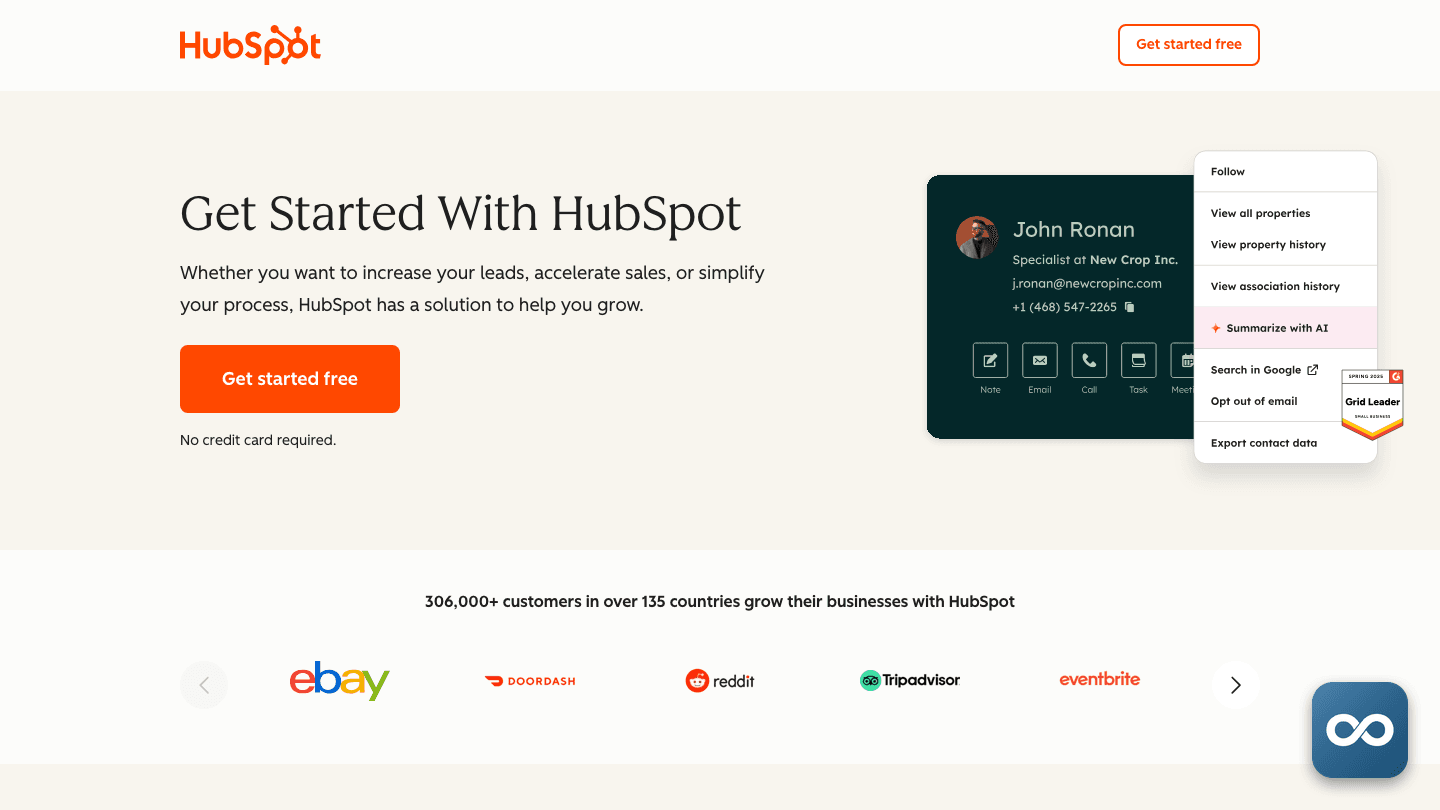
You sign up in the browser and land on Free CRM. HubSpot says no credit card is required and free access doesn't expire, with a ceiling of two users and 1,000 contacts. That is enough to run contact management, deal tracking and basic email integration before any money changes hands.
Set up Smart CRM as the system of record
You import or create contacts, companies, deals and tickets, then configure properties, pipelines, teams and permissions. Everything downstream reads from this, so the shape you give it here is the shape your campaigns, sequences and reports inherit.
Turn on Hubs and buy seats
You activate the Marketing, Sales, Service, Content, Data or Revenue functionality your workflows need, then buy the matching edition and paid seats. This is the step where the bill is decided. Marketing contacts, per-seat Sales and Service pricing, onboarding fees and credit allowances all attach here, none of them at signup.
Run the work, then extend it
Teams run campaigns, sequences, pipelines, tickets, content and reports through workflows, and Breeze Assistant and agents work over permitted CRM and connected-workspace context. Developers connect external systems through OAuth apps, APIs and marketplace integrations. Eligible Enterprise accounts can deploy serverless functions.
Features
Smart CRM
The shared customer record underneath everything else. Contacts, companies, deals, tickets and custom properties live here, and both people and Breeze agents read from the same data. Record limits, marketing-contact thresholds and API quotas vary by subscription. None of them are fixed platform ceilings.
Marketing Hub
Lead generation, omni-channel campaigns, marketing automation, marketing contacts and reporting. The catalog lists Starter, Professional and Enterprise editions, and marketing contacts are the meter that most often changes the final bill. An August 2025 Trustpilot reviewer alleged their account was upgraded for marketing contacts without exceeding the contracted threshold.
Sales Hub and Service Hub
Sales Hub covers prospecting, sales automation, deal pipelines, sequences and revenue workflows. Service Hub covers ticketing, support, retention workflows, customer health and an AI customer agent. Both are priced per seat for new customers. A July 2026 secondary capture reports Starter at $7 per seat per month, Professional at $90 and Enterprise at $150 for customers who signed after March 5, 2024.
Content Hub
Page creation, publishing and content management, aimed at brand-oriented content workflows rather than developer-first site building. A secondary capture put Professional at roughly $450 per month. Confirm it at checkout.
Data Hub and Revenue Hub
Data Hub covers data-management capabilities and Revenue Hub the sixth commercial area. Both names are recent. Older material still refers to Operations Hub and Commerce Hub, and product listings in circulation have not all caught up. Data Hub carries larger credit allowances than the other Hubs, and a secondary capture put its Professional edition at about $720 per month.
Breeze
HubSpot's AI family, covering Breeze Assistant plus customer-facing and prospecting agents. The Assistant works over CRM, meeting and connected-workspace context including Google Workspace, Microsoft 365 and Slack, and settings expose controls for AI access and data sharing. Breeze runs on documented third-party model frameworks, not one proprietary foundation model. HubSpot's AI Model Cards state no customer data is used for training and zero data retention applies to those frameworks.
Developer platform and APIs
OAuth apps, private and marketplace apps, CRM APIs, usage-limit tracking and, from platform release 2026.03, serverless functions. Rate limits are tiered. Privately distributed apps get 100 requests per 10 seconds on Free and Starter and 190 on Professional and Enterprise, with daily account limits of 250,000, 625,000 and 1,000,000 respectively. Public OAuth marketplace apps get 110 requests per 10 seconds per installing account.
What people use it for
- Generating and nurturing leads through content, campaigns, automation and AI
- Automating prospecting and prioritising high-value leads
- Managing deals, pipelines, sequences and forecasting in one place
- Handling support tickets and scaling service with an AI customer agent
- Creating, publishing and managing web and audience content
- Unifying customer data and connecting external systems through integrations and APIs
- Using Breeze to summarise, research and automate selected CRM work
- Building CRM integrations against documented APIs, OAuth apps and serverless functions
It is not a cheap simple CRM once you need advanced marketing contacts, automation, extra seats, onboarding or meaningful AI usage. The multi-Hub pricing and contract structure become complex. Trustpilot reviewers in 2026 cite that complexity as their main frustration.
Who it’s for
Pricing
Official pricingIndividual plans
Free
$0
per month
Free CRM for up to two users and 1,000 contacts, no credit card, no expiry.
Starter Customer Platform
$20
per seat per month
Essential marketing, sales, service, content and data tools, 1,000 marketing contacts and 500 monthly credits.
Business plans
Customer Platform Professional
$1,300
per month
Six included seats and 5,000 monthly credits; individual Hubs are priced separately, with Marketing Hub Professional at $890 per month plus $3,000 onboarding.
Customer Platform Enterprise
$4,700
per month
Eight included seats and 10,000 monthly credits; Marketing Hub Enterprise is $3,600 per month plus a required $7,000 onboarding fee.
Prices here come from HubSpot's Customer Platform, CRM and Marketing pricing pages and its legal Product & Services Catalog, checked in August 2026; regional currency and logged-in checkout can change what a buyer sees, and the Singapore dollar figures circulating in third-party listings were not confirmed against those pages. Free is genuinely $0 with no credit card, no expiry, two users and 1,000 contacts. Starter Customer Platform displays from $20 per seat per month, with a $7 per seat introductory figure reported on the live bundle page in a June 2026 capture that also showed 1,000 marketing contacts and 500 credits. Do not read a tier name as one price. The Customer Platform page showed Professional from $1,300 per month with six seats and 5,000 credits and Enterprise from $4,700 per month with eight seats and 10,000 credits, while the catalog lists Marketing Hub Professional at $890 per month with three Core Seats and $3,000 of mandatory onboarding, and Marketing Hub Enterprise at $3,600 per month with five Core Seats, $75 per month for additional Enterprise Core Seats and a required $7,000 onboarding fee. Credits are the AI meter. Allowances reset monthly and do not roll over, standard allowances are 500 on Starter, 3,000 on Professional and 5,000 on Enterprise for Smart CRM and most Hubs, with Data Hub and Customer Platform at 500, 5,000 and 10,000, and overage runs $0.010 per credit, $10 per 1,000-credit capacity pack, or pay-as-you-go invoiced in 10-credit increments. Capacity packs can trigger automatic upgrades when usage exceeds the monthly limit unless you select pay-as-you-go. Annual billing generally produces lower effective rates than monthly. The terms matter as much as the numbers: subscriptions auto-renew for the shorter of the prior term or one year, cancellation before the end of the current term is generally unavailable, prepaid and unused fees are non-refundable except where the customer terminates for HubSpot's cause, and turning off auto-renewal ends the subscription at the renewal date. There is no separate universal API price; request limits depend on subscription, app distribution and optional increases.
Traffic & reach
HubSpot does not publish these figures. They are third-party estimates, and they stand in for adoption without measuring it. A scrape captured in August 2026 put hubspot.com at about 42.8 million visits for June 2026, up 9.3% on May and roughly 123 million across the preceding three months; that figure has not been independently verified. The composition is the more useful part: 68.4% direct, 7.7% email, 7.4% referrals and only 7.3% organic search, which is the signature of logged-in usage, not discovery traffic. By country, the United States accounts for 35.7% of visits, the United Kingdom 9.3%, Japan 4.8%, France 4.6% and India 4.3%. Sessions average 16 minutes 5 seconds across 16.1 pages with a 23.1% bounce rate.
Visits, June 2026
42.8M
▲ 9.3% month over month
Nov '25Jun '26
Top countries
- United States36%
- United Kingdom9.3%
- Japan4.8%
- France4.6%
- India4.3%
Traffic sources
- Direct68%
- Email7.7%
- Referrals7.4%
- Organic search7.3%
- Organic social5.2%
- Paid search1.1%
- AI assistants1.1%
- Visits, last 3 months
- 123.1M
- Avg. visit
- 16m 05s
- Pages per visit
- 16.1
- Bounce rate
- 23.1%
- Brand searches / mo
- 1.6M
User reviews
Write a reviewNo reviews yet
Used HubSpot on something real? Write down what you made, what it cost and what the trade-off was. The next person can decide in about a minute from that.
Be the first to reviewWhat to know before you commit
What people actually rate it for. No current G2, Capterra or app-store aggregate turned up for HubSpot, so the usable sentiment is Trustpilot. A reviewer writing in late 2025 called the free CRM genuinely useful and not a crippled version, singling out contact management, deal tracking and basic email integration, and said the sales team adopted it with little resistance because the interface is clean and not overwhelming. Trustpilot's February 2026 summary echoes that some reviewers preferred its account and activity tracking and its interface to other CRMs. Integrated marketing, sales and service breadth is the recurring reason businesses pick it.
The complaint pattern is cost and complexity. Trustpilot's February 2026 summary says reviewers frequently found the pricing complicated, expensive for meaningful use and frustrating as needs grew past the free CRM. Even the positive late-2025 review said advanced automation became pricey. The same summary cites features not working as expected, integration problems and a confusing experience, though all of that comes from user reports, with no controlled testing behind it.
Billing and cancellation complaints line up with the written terms. An October 2025 reviewer describing August 2025 events alleged HubSpot automatically upgraded their account for marketing contacts despite never exceeding the contracted threshold, then applied inconsistent charges and suspended access despite payment, and said they filed an FTC complaint; that complaint and those allegations were not independently verified. A February 2026 reviewer described trying and failing to cancel while charges accrued. Trustpilot's summary reports difficulty reaching a person. None of that proves systemic misconduct, but it is consistent with terms that generally require cancellation at renewal and do not refund unused prepaid fees, so read the renewal terms before you sign.
AI data handling is documented, and not fully granular. HubSpot's AI Model Cards state that no customer data is used for training and that zero data retention applies to the documented third-party model frameworks, and its community explanation says those providers are contractually prevented from training on HubSpot customer data. HubSpot also advises against submitting sensitive information, and community discussion in March 2026 indicates the controls may not yet exclude individual records from every AI retrieval path. Accounts holding sensitive data carry additional restrictions. HubSpot's 2025 filing names security compromise and service outage as material business risks, and no specific 2025 or 2026 breach or outage surfaced.
Product names in circulation are stale. Current platform materials use Data Hub and Revenue Hub. A lot of third-party listings, and some older HubSpot-derived material, still say Operations Hub and Commerce Hub. If you're comparing feature lists or price sheets, confirm which naming the document is using before you match line items, and check pricing in your own market and currency.
The growth figures are the company's own. HubSpot reported roughly $3.1 billion in 2025 revenue and $45.9 million net income, and guided to between $3.678 billion and $3.686 billion for 2026. The customer and headcount numbers come from its Form 10-K and are the strongest dated figures available; the 2026 revenue figure is guidance, not realised revenue. HubSpot said 2025 was marked by acceleration upmarket and adoption of Breeze Customer Agent and Breeze Prospecting Agent, with CEO Yamini Rangan positioning the company around an agentic customer platform. Those outcome claims are vendor-reported.
Frequently asked questions
Company & links
- Company
- HubSpot, Inc.
- Founded
- 2006
- Founders
- Brian Halligan, Dharmesh Shah
- Leadership
- Yamini Rangan is CEO. Co-founders Brian Halligan and Dharmesh Shah remain prominent company leaders and board figures. Halligan is an MIT Sloan lecturer and former Groove Networks executive, and Shah is an MIT graduate who had founded and led an earlier software company before the two met at MIT. A complete current executive roster was not found in the sources reviewed.
- Funding
- Early rounds were $5 million from General Catalyst in 2007, $12 million from Matrix Partners in 2008 and $16 million from Scale Venture Partners in 2009 with Google Ventures participating, though secondary accounts do not reconcile the early totals. HubSpot listed on the NYSE under HUBS in October 2014 at $25 per share. Secondary sources report proceeds anywhere between $125 million and more than $140 million with differing implied valuations, so the IPO figures are unsettled. The company acquired PieSync in 2019 and The Hustle in 2021, with no acquisition of HubSpot itself on record, and authorised a share-repurchase programme in February 2026.
- Scale
- HubSpot's 2025 Form 10-K reported 288,706 customers in more than 135 countries and 8,882 full-time employees as of December 31, 2025; third-party data giving roughly 8,725 employees is weaker than the filing. The company reported approximately $3.1 billion in 2025 revenue and $45.9 million net income, and guided to between $3.678 billion and $3.686 billion for 2026. All of these are company-reported figures from HubSpot's filings and investor communications, and the 2026 number is still guidance.
Try HubSpot on work you already know
A task you’ve done before is the fastest way to judge whether HubSpot fits your workflow and budget. Check the current plan terms on the official site before you subscribe.