
 Listing checkedFreemiumFree TrialPaidContact sales
Mailchimp
Email and SMS marketing platform with automations, landing pages, audience segmentation and AI-drafted campaigns, priced by contact count.
- Ratings
- No member reviews yet
- Price
- Freemium
- Last updated
Key takeaways
- Mailchimp is the email and SMS marketing platform Intuit bought in 2021 and now brands Intuit Mailchimp. It bundles campaign email, behavior-triggered automations, landing pages, signup forms, audience segmentation, social posting and reporting in one browser app, and the review sites rate it well: 4.3/5 from 17,557 G2 reviews as of August 2026 and 4.5/5 from 17,624 Capterra reviews in 2026.
- The company is in a different phase than the one that made it famous. Intuit began reporting Mailchimp as a standalone segment on August 1, 2026, and guided the segment to $1.256 to $1.266 billion of FY2027 revenue with growth of 0% to -1%. Those figures are Intuit's own. Co-founder Ben Chestnut stepped back to a Business Advisor role in 2023, and Rania Succar, an Intuit SVP, runs it.
- Pricing is by contact count, not a flat sticker price. As of August 2026 there are four Marketing plans (Free, Essentials, Standard, Premium) plus Pay As You Go credit packs. The Free plan covers 250 contacts and 500 sends a month with a 250-send daily cap. Essentials and Standard start their pricing at the 500-contact tier, Premium at 10,000 contacts, and all rise as your list grows, so treat the number on the pricing page as a floor.
- Third-party traffic estimates put the mailchi.mp domain at about 9.5 million visits in June 2026, down from 12.2 million in January 2026 and 8% below May. The figure is unverified, and mailchi.mp is Mailchimp's landing-page and link domain rather than mailchimp.com, so it likely measures campaign-link clicks more than product visits.
- The biggest caveat is what happens as the list grows. Cost escalation is the most consistent complaint across independent reviews, advanced automation and segmentation sit on higher tiers, and Trustpilot is at roughly 2.6 to 2.7/5 on billing, cancellation, support and 2FA lockout complaints. A January 2023 social-engineering incident affected 133 accounts; a 2025 ransomware claim against Mailchimp was disputed by Intuit and remains unproven.

What is Mailchimp?
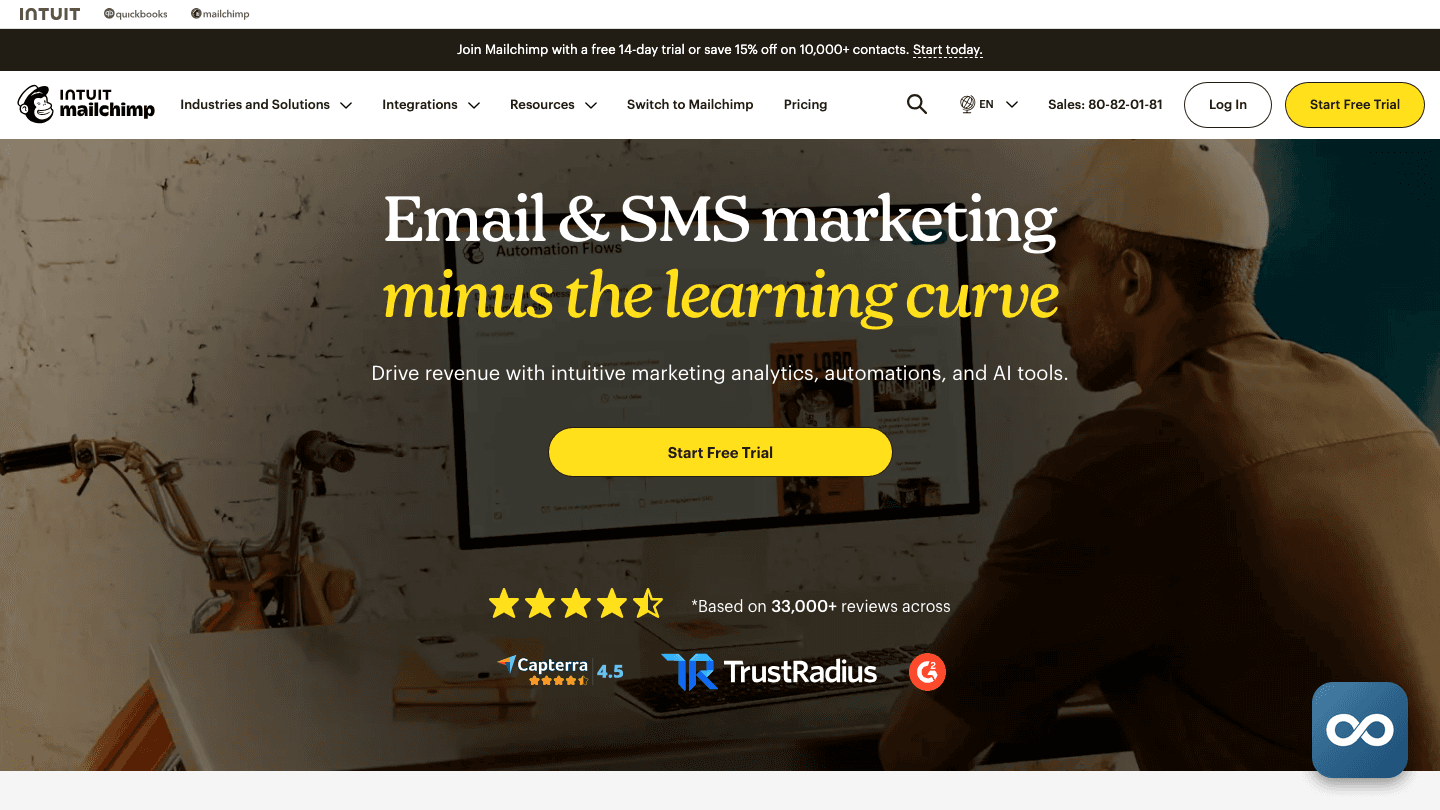
Mailchimp is a hosted marketing platform for sending email and SMS campaigns and running the automations, forms and pages that feed them. The company, The Rocket Science Group, started in Atlanta in 2001 as a side project of Ben Chestnut and Dan Kurzius and grew into the default email tool for small businesses without taking venture money. Intuit acquired it in November 2021 for roughly $12 billion in cash and stock. The homepage as of August 2026 describes it as an "Email & SMS Marketing Platform" for creating, automating and optimizing customer communications.
What's different is that the audience data and the campaign production live in the same account. You import or collect contacts, tag and segment them by behavior and purchase history, then build newsletters, welcome series, abandoned-cart and win-back journeys against those segments without exporting anything. Landing pages, signup forms, surveys, social posts and paid ads on Facebook, Instagram and Google run from the same workspace, and reporting ties opens, clicks, unsubscribes and revenue back to the audience. Intuit Assist, the AI layer, drafts subject lines, copy and full emails for you to edit before sending.
Around it sits a market that has specialized where Mailchimp stayed general. Klaviyo goes deeper on ecommerce and Shopify data, ActiveCampaign on CRM-style automation, Kit on creators and newsletters, SendGrid on developer-driven transactional email. Mailchimp's answer is breadth. It has 300-plus integrations, which is why it still lands with start-ups, small and mid-market companies, agencies and ecommerce teams that want one subscription rather than four.
How it works
Set up an audience
You create an account in the web app, then import contacts or collect them through signup forms and integrations. This is also where you configure consent settings and audience fields. The Free plan lets you start without paying, as long as you stay inside its 250-contact and 500-send limits.
Pick the campaign or journey
From the campaign and automation workspace you choose an email, landing page, social post, SMS or multi-step customer journey. You define recipients by audience, tags, segments or behavior, so a welcome sequence and a win-back sequence can draw on the same list with different rules.
Design and write
You start from a template or the drag-and-drop builder and apply your own brand styling. Intuit Assist can propose copy and layouts from a prompt or from a blog URL, and can turn that source into email sections or a complete draft. Mailchimp says AI output can be inaccurate, non-unique or legally unsuitable, so every draft needs a human pass before it goes out.
Send, automate, then read the report
You test and schedule the campaign, or publish a behavior-triggered workflow such as a welcome series, abandoned-cart recovery, purchase follow-up or win-back message. Reports then show opens, clicks, unsubscribes, revenue and audience activity, and Google Analytics plus the integrations directory carry the data into the rest of your stack.
Features
Email Marketing and Templates
Prebuilt templates, drag-and-drop editing, custom designs and campaign testing produce responsive emails without code. This is the part reviewers cite most often as the reason a non-designer can ship a professional-looking campaign.
Marketing Automation
Behavior-triggered workflows cover the standard ecommerce and subscription set: welcome series, purchase follow-ups, abandoned-cart recovery and win-back messages. Basic automation is available on lower plans. The more advanced automation needs Standard and above.
Customer Journeys
Multi-step, conditional automation that branches on audience behavior and customer events and sends different messages at different times. This is where the segment data pays off, and it is the feature reviewers flag as tier-gated.
Audience Management
Contact records, tags, segments, signup forms, surveys and behavioral targeting organize first-party data. Free includes one audience. The paid tiers raise the contact ceilings to 50,000, 100,000 and 200,000.
Websites and Landing Pages
You can build campaign pages, lead-capture pages and a simple branded web presence inside the platform, so a form and the automation it triggers live in one place. Landing pages and forms are available on the Free plan.
Social Media and Ads
You can schedule organic posts and run paid campaigns across Facebook, Instagram and Google from the same account. The lead-generation pages also reference syncing audiences to Meta, TikTok and Google.
Intuit Assist and AI Content
The AI assistant suggests subject lines and copy, turns a blog URL into email sections, and generates complete email drafts to review and edit. Mailchimp's CRM beta terms name Microsoft Azure and OpenAI as third-party processors for that beta, which is the only place the retrieved pages identify the underlying model infrastructure.
What people use it for
- Sending newsletters and promotional emails personalized by segment
- Welcoming new subscribers and recovering abandoned carts with automations
- Building landing pages, signup forms and surveys to grow a list
- Scheduling social posts and running paid acquisition campaigns from the same workspace
- Segmenting customers by behavior, purchase history or engagement
- Measuring opens, clicks, revenue, unsubscribes and audience growth per campaign
- Drafting email copy, subject lines and layouts with Intuit Assist
- Connecting the audience to ecommerce, CRM, analytics and ad platforms through 300-plus integrations
It isn't a low-cost choice for large or fast-growing lists, and Capterra reviewers report that advanced automation and customization are restricted or expensive on the lower tiers.
Who it’s for
Pricing
Official pricingIndividual plans
Free
$0
per month
Up to 250 contacts and 500 sends a month with a 250-send daily limit, one audience, one seat, limited templates, basic reporting, forms and landing pages
Essentials
By contact tier
per month
Starting price set at 500 contacts and rising with your list; up to 50,000 contacts and 10 sends per contact a month, more support, the feature basis for Pay As You Go
Standard
By contact tier
per month
Starting price set at 500 contacts and rising with your list; up to 100,000 contacts and 12 sends per contact a month, data-backed insights, recommendations and more advanced automation
Premium
By contact tier
per month
Starting price set at 10,000 contacts and rising with your list; up to 200,000 contacts and 15 sends per contact a month, advanced segmentation, testing and support
Pay As You Go
Credit packs
one-time
Essentials-level features, one credit per recipient, credits expire after 12 months and are not refundable; pack prices vary by currency and were not published
Business plans
Custom plans above 200,000 contacts
Custom
contact sales
Mailchimp says it can customize plans beyond Premium's 200,000-contact ceiling; team-seat, SSO and API prices were not published at our last check
As of August 2026 Mailchimp sells four Marketing plans and a credit option. Free is $0 for up to 250 contacts and 500 sends a month with a 250-send daily limit, one audience, one owner seat, limited templates and basic reporting. Exceed 250 contacts and sending goes on hold until you cut contacts or upgrade. Essentials, Standard and Premium are monthly recurring plans priced by contact tier, so the advertised starting price applies to the 500-contact tier (10,000 contacts for Premium) and climbs with your list. Essentials caps at 50,000 contacts and 10 sends per contact per month, Standard at 100,000 contacts and 12 sends, Premium at 200,000 contacts and 15 sends, with custom plans above that. Pay As You Go is a non-recurring credit pack with Essentials-level features. Each recipient costs one credit, so one email to 100 people spends 100 credits. Credits expire after 12 months and are not refundable, and package prices vary by currency and were not published in the retrieved pages. The pricing page advertises a 14-day free trial for selected paid functionality. The eligibility, auto-renewal and feature details of that trial were not fully exposed, and it is separate from the permanent Free plan. Refunds follow the written terms. Annual paid Marketing plans carry a 60-day money-back guarantee requested through customer service, while monthly plans and unused credits are not refunded except in cases such as system malfunction or termination without cause. You can pause a Marketing plan for 3 or 6 months, twice in any 12 months, but deleting the account permanently removes audiences, archives and reports and requires any outstanding balance to be paid first. Annual discounts, team-seat prices, SSO and API pricing were not exposed, and Mailchimp has changed limits and pricing over time, so check the live pricing page in your own currency before budgeting.
Traffic & reach
These are third-party estimates from our last check, not Mailchimp's numbers, and the scrape's monthly total could not be independently verified. The estimates are attached to mailchi.mp, the domain Mailchimp uses for hosted landing pages and campaign links, not mailchimp.com, so a large share of these visits are likely recipients clicking links in someone's newsletter rather than marketers using the product. And the trend runs down: from about 12.2 million visits in January 2026 to about 9.5 million in June, with roughly 57% arriving direct and just over half from the United States.
Visits, June 2026
9.5M
▼ 8.3% month over month
Nov '25Jun '26
Top countries
- United States51%
- United Kingdom8.4%
- Canada7.2%
- Australia3.9%
- Spain2.1%
Traffic sources
- Direct57%
- Referrals18%
- Email9.1%
- Organic social7.3%
- Paid social3.6%
- Organic search2.8%
- Display ads1.6%
- Visits, last 3 months
- 30.5M
- Avg. visit
- 0m 58s
- Pages per visit
- 1.6
- Bounce rate
- 75.8%
- Brand searches / mo
- 2K
User reviews
Write a reviewNo reviews yet
Used Mailchimp on something real? Write down what you made, what it cost and what the trade-off was. The next person can decide in about a minute from that.
Be the first to reviewWhat to know before you commit
What people rate it for. Independent reviews credit the drag-and-drop editor, templates, onboarding, audience management, automation and clear open-and-click analytics. A Capterra reviewer in 2026 called it "reliable and beginner-friendly" and said it produced professional campaigns without technical or design experience. G2's August 2026 distribution was 59% five-star and 32% four-star across 17,557 reviews, and a June 2026 MailCon comparison put it at 4.4/5 on Gartner and 4.2/5 on TrustRadius alongside 4.3 on G2 and 4.5 on Capterra.
The cost complaint is a pattern. Pricing that rises sharply as contact lists grow is the most consistent criticism across Capterra and a 2026 review synthesis, with advanced automation, segmentation and customization gated to higher tiers. That synthesis counted roughly 55 pricing complaints, 45 feature-limit complaints, 32 learning-curve complaints and 23 customization or testing complaints in its sample; those are one reviewer's counts, not a representative survey. Capterra reviewers also describe the interface as crowded once you manage several campaigns, audiences or settings.
Trustpilot tells a harsher story. Trustpilot sat at roughly 2.6 to 2.7/5 from about 1,383 to 1,400 reviews in 2026, and the complaints are about the account rather than the emails: billing transparency, overage charges, difficulty cancelling, two-factor authentication loops that lock people out, slow or generic support, and designs or survey data reportedly disappearing after changes or downgrades. These are user reports, not adjudicated findings, but they recur across the review sites and are worth reading before you commit a list.
Security incidents, one confirmed and one disputed. On January 11 to 13, 2023, Mailchimp disclosed that a social-engineering attack on employee credentials gave an unauthorized actor access to a support and account-administration tool. The company said 133 accounts were affected, suspended suspicious accounts and notified customers. In July and August 2025 the Everest ransomware group claimed a Mailchimp breach with a 767 MB dataset. Reporting said samples looked like CRM or marketing exports, and Intuit stated its investigation found no evidence of compromise or exfiltration from Mailchimp or Intuit systems. A February 2026 ThirdProof assessment rated Mailchimp a moderate vendor risk on the strength of both, and said its security certifications were not independently confirmed.
Read the AI data terms. The CRM beta terms say Microsoft Azure and OpenAI may process inputs and outputs, and that Mailchimp and OpenAI may use them to develop and improve the beta and similar products, with an opt-out in account settings. That language is specific to the beta, and you shouldn't assume it covers every AI feature, but it is the only published statement of how Mailchimp's AI handles your data that we found.
The scale figures are Mailchimp's and Intuit's own. The founders page says over 1,500 employees and 13 million global users, neither dated, while an entity estimate lists 974 workers, so headcount is unreconciled. Intuit's FY2027 guidance of $1.256 to $1.266 billion in Mailchimp revenue and 0% to -1% growth is self-reported and points to a mature, flat business. Intuit's segment restructuring may precede further packaging changes.
Frequently asked questions
Company & links
- Company
- The Rocket Science Group
- Founded
- 2001
- Founders
- Ben Chestnut, Dan Kurzius
- Leadership
- Rania Succar is CEO of Mailchimp and SVP of Intuit's QuickBooks Money Platform. Succar took over in 2023 when co-founder Ben Chestnut moved to a Business Advisor role. Chestnut and Dan Kurzius founded The Rocket Science Group in Atlanta in 2001 after meeting at Cox Interactive Media; Chestnut had studied industrial design at Georgia Tech and taught himself web development.
- Funding
- Mailchimp was bootstrapped with no outside venture funding until Intuit bought it. The deal, agreed in September 2021 and completed in November 2021, was roughly $5.7 billion in cash, $6.3 billion in Intuit shares and about $200 million of employee RSUs, around $12 billion in total. We found no priced rounds, later financings or independent valuations. From August 2026 Intuit reports Mailchimp as a separate operating segment.
- Scale
- Mailchimp's founders page claims over 1,500 employees and 13 million global users, both self-reported and undated, while an entity estimate lists 974 workers. Intuit's FY2027 guidance, also self-reported, puts Mailchimp revenue at $1.256 to $1.266 billion with 0% to -1% growth. We found no independently audited revenue figure for Mailchimp alone.
Try Mailchimp on work you already know
A task you’ve done before is the fastest way to judge whether Mailchimp fits your workflow and budget. Check the current plan terms on the official site before you subscribe.