
 Listing checkedFreemiumContact sales
Leonardo.Ai
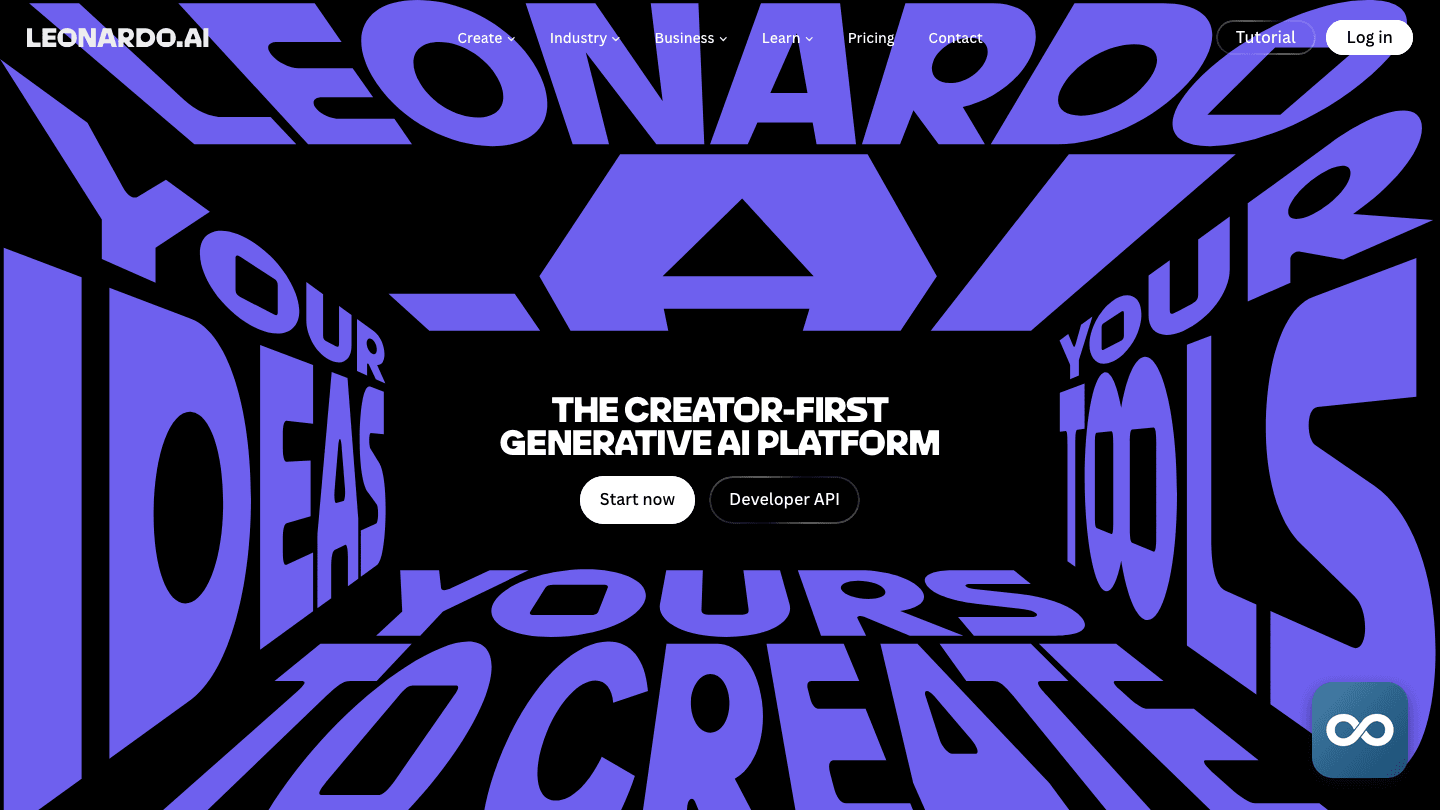
Browser platform and pay-as-you-go API for generating and editing images and video across Leonardo's own and third-party models, with a permanent free tier.
- Ratings
- No member reviews yet
- Price
- From $12/mo
- Last updated
Key takeaways
- Leonardo.Ai is a browser platform plus an API for generating and editing images and video, owned by Canva since July 2024 and still run as its own product. It puts Leonardo's own models such as Lucid Origin and Phoenix next to third-party engines such as Nano Banana, GPT Image, Veo, Seedance and Kling, and adds editing, custom model training, Blueprints and 3D texture generation in the same workspace.
- The product has moved well past text-to-image. Its old description of "image generation, AI Canvas and textures" is stale. What the current platform sells is image-to-video, video editing, character consistency, repeatable Blueprint workflows and a pay-as-you-go API with LoRA training. Control over one-click generation has always been the pitch, which is also why the settings panel is dense.
- Pricing runs on Fast Tokens. Free is a permanent $0 tier with 150 tokens a day; paid plans are Essential at $12, Premium at $30 and Ultimate at $60 a month as of August 2026, with annual billing advertised at up to 20% off. A token isn't an image. Cost depends on model, resolution and operation, and premium modes, upscaling and video burn through an allocation quickly. Free output is public by default and, under the terms, its rights belong to Leonardo.
- Traffic is large and flat. Third-party estimates put June 2026 somewhere between 9.9 and 10.9 million visits, down about 9% on May, and the monthly figure has hovered between 9 and 11.3 million since November 2025. These are estimates, not company numbers.
- The biggest caveat is token and billing transparency. Complaints through 2026 centre on opaque token consumption, failed generations that still cost tokens, slow queues at peak times, and one enterprise reviewer's allegation of a broken cancellation process and a $3,600 refund left unresolved for months. That's a single account, but refunds are manually assessed and exclude change of mind, so read the terms before paying.

What is Leonardo.Ai?
Leonardo.Ai is a web platform and API for generating and editing images and video. It started in Sydney in 2022 as a text-to-image tool built around an idea that set it apart from its rivals, that the person making the picture should get more control than a prompt box and a lucky roll. Live Canvas, where a rough sketch and a prompt steer the result together, is the clearest expression of that, and it's why CEO J.J. Fiasson reached for Leonardo da Vinci's name, the artist who was also an inventor.
What sets it apart in 2026 is breadth under one login. The model picker mixes Leonardo's own models, including Lucid Origin, Lucid Realism, Phoenix 1.0 and 0.9 and the Motion video models, with third-party engines such as FLUX Dev and Schnell, Nano Banana, GPT Image, Veo, Seedance, Kling, Hailuo 2.3 and Wan 2.6. Around the picker sit an AI Image Editor, a canvas editor, image-to-video and video editing, custom model and LoRA training on a small set of reference images, Blueprints that package a repeatable workflow, and a 3D texture generator that takes a UV-mapped OBJ file. Developers reach the same capabilities through a pay-as-you-go API.
Canva bought the company in July 2024 for an undisclosed mix of cash and stock and said Leonardo would keep operating independently. As of August 2026 it does, with its own homepage, pricing and API, and the operating entity is still Leonardo Interactive Pty Ltd in Sydney. What you need to know up front is the token economy. Every plan is metered in Fast Tokens whose cost changes by model and operation, and the Free tier makes your creations public and assigns their rights to Leonardo.
How it works
Sign in and pick a workflow
Create a free account in the browser; the Free plan works without payment. From there you choose what you're making: an image, an edit of an existing image in the AI Image Editor or canvas, a video clip, a custom model or preset, or a texture set for a 3D model.
Prompt, upload, and set the controls
Type a prompt and optionally add reference images, or upload an OBJ file if you're texturing. Then choose the model, dimensions, quality and the other generation settings. This step sets the token cost, because model, resolution and operation each change how many Fast Tokens the job consumes. OBJ files need UV mapping before the texture tool will accept them.
Iterate on the results
The platform returns variations you can edit, upscale, animate into video or regenerate. On paid plans this can happen privately; on Free the output lands in public creations. How many jobs run at once and how many can wait in the queue depends on the plan, from limited concurrency on Free to six concurrent and 20 queued generations on Ultimate.
Export, or automate it
Download the result into your own pipeline, or skip the browser entirely. The API exposes text-to-image, image-to-image, image-to-video, LoRA training, presets and upscaling, with webhooks that report when a texture job finishes. It bills per use from a separate credit balance rather than from your subscription tokens.
Features
Image Generation
Text-to-image across Leonardo's fine-tuned models and the third-party catalog, with model selection and adjustable settings for size and quality. This is the core the rest of the product grew from, and it's still the part that earns the strongest praise for output quality and speed.
AI Image Editor
Refine an existing image with prompts and references: remove or replace objects, clean up details and improve quality without starting the generation over. The older "AI Canvas" name still appears in some descriptions, but the current product frames editing more broadly, with a canvas editor for layout, element adjustment, text and detail work.
Video Generation and Editing
Image-to-video and video generation now sit front and centre, running on Leonardo's Motion 1.0 and 2.0 models as well as Veo, Seedance, Kling, Hailuo 2.3 and Wan 2.6. Ultimate adds relaxed unlimited video generation on selected models, queued and demand-dependent. Any description of Leonardo as an image-only tool is out of date.
Custom Models and LoRA Training
Train a model on a small collection of images to hold a subject, style or brand consistent across generations. The API exposes the same LoRA training alongside custom presets, which is how a team keeps a character or product looking the same from asset to asset.
Blueprints and Presets
Blueprints and presets package a repeatable generation workflow so you're not rebuilding settings each time. How many Blueprints can run concurrently is a plan feature: two on Essential, six on Ultimate.
3D Texture Generation
Upload a UV-mapped OBJ model and the tool generates multiple textures for it, a workflow aimed at game props and environments. Through the API, a webhook can report completion so the job slots into a build pipeline.
The API
Programmatic access to text-to-image, image-to-image, image-to-video, LoRA training, presets and upscaling. It's pay as you go rather than a monthly tier. New accounts get $5 of credit, credit doesn't expire, automatic top-ups are available, and up to ten generations can run concurrently.
What people use it for
- Character sheets and consistent character design across a series of images
- Game props, environments and textures for 3D models
- Concept art and world-building
- Marketing creatives, ad variations and product photography
- Fashion campaigns and editorial imagery
- Architecture and interior-design visualisation
- Graphic layouts and social content
- Image-to-video and creative prototyping driven from the API
It isn't a substitute for deterministic 3D modelling, pixel-perfect typography and layout, or guaranteed production consistency. Output stays probabilistic and depends on the model, the queue and the tokens you have left.
Who it’s for
Pricing
Official pricingIndividual plans
Free
$0
per month
150 Fast Tokens a day, 150-token bank, public creations, presets, basic quality settings, one collection, limited concurrency
Essential
$12
per month
8,500 Fast Tokens a month, 25,500 bank, private creations, top-ups, 2 concurrent and 5 queued generations, 2 concurrent Blueprints
Premium
$30
per month
25,000 Fast Tokens a month, 75,000 bank, private creations, 3 concurrent and 10 queued generations, relaxed unlimited images on selected models
Ultimate
$60
per month
60,000 Fast Tokens a month, 180,000 bank, private creations, 6 concurrent and 20 queued generations, relaxed unlimited images and video on selected models, 6 concurrent Blueprints
Business plans
Starter
$72
per month
$24 a seat before tax, 75,000 shared tokens, role-based access and collaboration
Growth
$144
per month
$48 a seat before tax, 180,000 shared tokens, 540,000 bank, 60,000 Fast Tokens per seat
Business
Custom
contact sales
High-volume generation, brand consistency, workflow integration and API access; no public price, seat minimum or quota sheet
Leonardo meters everything in Fast Tokens, and one token doesn't buy one image. What a job costs depends on the model, the operation, the resolution and the settings, and the pricing page publishes no single per-image rate, no top-up pack prices and no rollover beyond each plan's stated bank capacity. Free gets 150 tokens a day, reset daily, with a 150-token bank; paid allowances of 8,500, 25,000 or 60,000 tokens a month replenish at the billing-month boundary and can be banked up to 25,500, 75,000 or 180,000 tokens. "Unlimited" on Premium and Ultimate means relaxed-mode generation on a named list of models, queued, and throttled by demand and concurrency. Cancelling stops renewal but the plan runs to the end of the period, and unused paid tokens expire when the account drops to Free. Refunds are assessed manually and cover defective or misdescribed service, tokens that were never delivered, persistent technical faults or major defects. Changing your mind doesn't qualify. API credit is separate, pay as you go, starts with $5 free and doesn't expire. Prices are as of August 31, 2026, before tax. No price change or tier rename turned up in the preceding 12 months, but token rates and relaxed-model eligibility move often enough that the live page is the only reliable source.
Traffic & reach
These are third-party estimates, not company numbers, and two of them disagree. One put June 2026 at about 9.9 million visits, another at 10.9 million, so treat the figure as a range. The shape says more than the size. Monthly visits have sat between roughly 9 and 11.3 million since November 2025 with no clear trend, June was down about 9% on May, and close to half of visits arrive direct with another third from organic search, the pattern of a bookmarked working tool rather than one people find by chance. Visitors stay about seven minutes and view around ten pages. The United States leads at about 14%, followed by India, Russia, Indonesia and Brazil.
Visits, June 2026
9.9M
▼ 8.9% month over month
Nov '25Jun '26
Top countries
- United States14%
- India11%
- Russia8.9%
- Indonesia6.9%
- Brazil3.7%
Traffic sources
- Direct47%
- Organic search35%
- Referrals7.4%
- AI assistants4.8%
- Organic social4.0%
- Email1.0%
- Visits, last 3 months
- 31.6M
- Avg. visit
- 7m 03s
- Pages per visit
- 10.5
- Bounce rate
- 31.1%
- Brand searches / mo
- 1.5M
User reviews
Write a reviewNo reviews yet
Used Leonardo.Ai on something real? Write down what you made, what it cost and what the trade-off was. The next person can decide in about a minute from that.
Be the first to reviewWhat to know before you commit
What people rate it for. Reviewers commonly credit output quality, generation speed, the range of models and being able to generate, edit, upscale and animate in one workspace. A July 2026 review aggregation reported G2 at 4.5 out of 5 from 34 reviews and Capterra at 4.6 from 15, both small samples. CNET's July 2024 coverage singled out the control-first approach and Live Canvas, sketch plus prompt rather than prompt alone, as what separates it from one-click generators.
Tokens are the recurring complaint. The pattern in 2026 is that 150 free tokens a day sounds like 150 images and isn't. A May 2026 analysis of user reports described premium generation modes costing 8 to 16 tokens per image, free allocations gone in roughly 10 to 15 higher-cost generations, and queue delays on top. A February 2026 Trustpilot review, seen only as a search result, titled its complaint a "token-drain" design. Users also report failed generations that still consumed tokens, prompts that were not followed, uneven character and video quality, and API downtime during demand spikes. These are reported experiences, not measured service levels.
The interface can overwhelm. The same July 2026 review roundup that praised the output said beginners can find the sliders, modes and prompt settings too much at first. The control that professionals value is the learning curve everyone else pays.
One billing allegation deserves caution. A July 2026 review aggregation carried an enterprise reviewer alleging a broken cancellation process, months of silence from support, API downtime and an unresolved $3,600 refund. It's one unverified account, not evidence of a pattern, but the published refund policy is narrow and manually assessed, so know the terms before a large commitment.
Free means public, and Leonardo's. Under the terms updated in January 2026, output from Free accounts is public by default, searchable and potentially indexed, and its rights vest in Leonardo. Leonardo can use public content, whether from Free or from a paid user who chose public, for service improvement and model training. It won't use private paid content for training without express written consent. A Reddit user quoted by a search aggregator also complained about changes to model fine-tuning and the removal of legacy features they had paid for.
No incidents on record, and a parent to watch. No data breach, regulator action, lawsuit or formal security incident turned up in the terms, privacy pages or press through August 2026, though absence in a search is not proof. Canva has owned the company since July 2024 and says it operates independently. Whether that changes data governance, API terms or branding as integration continues is the thing to re-check.
Alternatives to Leonardo.Ai
 OpenArtBrowser studio that generates images with GPT Image 2, Nano Banana Pro and Seedream 5.0, then edits, upscales, trains characters and makes video on one canvas.
 GrokxAI's conversational assistant with real-time web and X search, voice mode, and Grok Imagine image and video generation on web, iOS and Android.
 EmergentDescribe a web or mobile app in plain language and Emergent's coding agent builds, hosts and deploys it, metered in monthly credits.
 ClaudeAnthropic's AI assistant for writing, coding, research and analysis, with a permanent free tier and paid plans from $20 a month.
 MeshyBrowser workspace that turns text prompts and reference images into textured, riggable 3D models, with printability checks, a REST API and an MCP server.
 ArtlistArtlist's browser workspace for generating images, video, music, voiceovers, avatars, lip sync and dubbing on one shared credit balance.
Frequently asked questions
Company & links
- Company
- Leonardo Interactive Pty Ltd
- Founded
- 2022
- Founders
- J.J. Fiasson, Ethan Smith
- Leadership
- J.J. Fiasson is CEO and a co-founder, and has said the name comes from Leonardo da Vinci being both an artist and an inventor. Company databases name Fiasson and Ethan Smith as founders, while Wikipedia lists a wider founding team of Christopher Gillis, Jachin Bhasme, Peter Runham and Sami Ede. No current executive roster beyond the CEO is confirmed.
- Funding
- A Series A reported in late 2023 at approximately US$31.3 million or A$47 million, depending on the source, from Blackbird Ventures, Smash Capital, Side Stage Ventures, TIRTA Ventures, Gaorong Capital, Sierra Ventures and Samsung Next; the currency and date are unreconciled. TechCrunch puts total pre-acquisition capital at more than $38.8 million, while PitchBook and Tracxn put it at about $31.3 million. Canva acquired the company on July 29, 2024 for an undisclosed mix of cash and stock.
- Scale
- About 120 employees were to join Canva at the acquisition, per TechCrunch. Third-party databases in 2026 report anywhere from 102 to about 206 staff, so treat headcount as a 100 to 210 range. The company has published no revenue, profitability or customer count; third-party revenue estimates exist but are not company figures.
Try Leonardo.Ai on work you already know
A task you’ve done before is the fastest way to judge whether Leonardo.Ai fits your workflow and budget. Check the current plan terms on the official site before you subscribe.